13 Tech Predictions for 2026
- Adrien Book

- Dec 28, 2025
- 14 min read

What. A. Year. Trump was sworn in. He started a trade war, but what’s one more war amongst friends? Did you even say thank you? A ceasefire was declared (ish). But not in California. Or France. Or Italy. Nothing Beats a Jet2 Holiday, except where the climate is bad, which is ev-er-y-where. Maybe Katy Perry had a point. Lightning round: Pope (Argentinian) out, Albanese (Australian, not Albanian) in, Ozzy (English, not Australian) out, Pope (American) in. Evil (deportation), evil (starvation), evil (monsters), evil (island). But also… Labubu Matcha Dubai Chocolate? K-Pop Demon hunters: up up up. Gen Z: up up up(rising). Your English teacher and your gym teacher are getting married. Bezos got married; y’all billionaires and still look like the host and spokesmodel of a 1972 gameshow. Shots fired. Shots fired. 6–7 this, 6–7 that… I sure could use 6 or 7 shots.
History has always rhymed; in 2025 it did so faster than ever.
But we’ve made it. And though many (but not all) of my predictions for 2025, 2024, 2023, 2022, 2021, 2020, 2019 and 2018 have fallen flat, there are two reasons why you should keep reading this article. Firstly… because predictions are fun! Secondly, because the knowledge gained through planning for the future is crucial to the selection of appropriate actions as events unfold. Predictions can act as catalysts to steer the conversation in the right direction. We don’t know the answers, but we can at least ask useful questions.

1. Self-driving goes mainstream
It’s very likely you’ve never gotten into a “real” self-driving car. 99.9% of the world’s hasn’t. And it has led most to conclude that the technology is some ways off.
It’s not. Waymo went from 38 000 paid rides per month in 2023 to 1 million by mid-2025. The company is lapping the competition, logging 100 million fully autonomous miles versus Tesla’s 1.25 million with a safety driver. Furthermore, a study evaluating tens of millions of miles driven by Waymo found that its autonomous cars were involved in 96% fewer vehicle-to-vehicle crashes, resulting in 90% fewer bodily-injury claims, and 92% fewer pedestrian injuries compared to cars driven by humans. This is happening.
And it’s happening next year in Dallas, Denver, Detroit, Houston, Las Vegas, Miami, Nashville, Orlando, San Antonio, San Diego, Washington… and maybe London. And maybe Tokyo. The last two are important because if they can make it there (and the data shows they can), they can make it anywhere.
Resolution criteria: At least three major capitals have a publicly available driverless robotaxi service (no safety driver), running for >3 consecutive months and delivering >250 000 paid rides/month per city.
2. Calls for strikes grow as driving jobs shrink
The autonomous driving discussion revolves mostly around transporting people. It’s understandable in a way: accidents get clicks. But moving things is both more profitable and less dangerous. And that makes it perfect for automation. With increasingly capable self-driving (see above), we will soon see companies invest more of their logistics budget on autonomous delivery trucks. Amazon will be first, then the likes of IKEA, or any other company for which last mile is an absolute pain.
This will mean job losses, and loads of them. There are 3 million truck drivers in the US alone today, and some will lose their job to a robot.
If a factory closes, 600 jobs are lost on average. 10% of truckers losing their jobs? That’s the equivalent of 500 factories closing down; enough to cause open rebellion in any industry. And so the strikes will come. Likely small at first, as truck driving is not a well-organised profession. But it will be an indicator of things to come. Sadly for drivers, we’ve seen this move before…
Resolution criteria: One or more large-scale work stoppages by professional drivers (> 5,000 participants) in a major economy, where unions explicitly cite automation as a core grievance.
3. Gen-Z riots in the US and Europe
Truckers won’t have it really bad in 2026. Young people will.
Retail (where work life begins for one out of four youths) is increasingly robotised; Walmart, the US’ largest employer, recently announced a hiring freeze as it focuses on automation. Meanwhile, entry-level white-collar jobs are getting AIed; since 2023, job postings for entry-level roles have fallen by more than 35% in the US, and 63% of executives admit that AI will likely take over some entry-level tasks. This is a code red for anyone entering the workforce today and tomorrow.
In 2025, Nepalese, Moroccan and Malagasy 20-somethings rioted over corruption and the lack of economic perspective. As most Western 22-year-olds today have more in common with a Nepalese teenager than with their 65-year-old neighbors, a repeat in the Western world is likely.
Resolution criteria: The US and Europe see multi-city riots where most participants are 18 to 30, and youth economic prospects are cited as a primary grievance by organizers and major news reporting.
4. A data center gets bombed
Any regulation softening the impact of AI (if any are introduced) will take years to be implemented (The EU’s AI Act took years to pass, came into force in 2024 and will only become fully applicable in 2027). In the meantime, AI will take jobs. If they’re smart (not a given), populist parties the world over will seize on it to secure more votes in upcoming elections.
Their long-lasting gripe was against immigrants… taking jobs. And what happened? Immigrant hotels got attacked (in the UK in particular). Which is a bad look for everyone involved, because immigrants are people.
Data centers, however, are not people. They are owned by billionaires. They do not create a great many jobs; they power AI which will take millions of them (up to 40% of them according to the IMF). They use precious water. They increase electricity costs wherever they go. And politicians won’t do anything because… billionaires.
There are a lot of reasons to want to destroy a data center today. I believe the angriest cohorts in politics will realise the same. Unrelated: here’s how to make a Molotov cocktail.
Resolution criteria: At least one publicly intentional attack on an operational commercial data center is reported, causing major damage and either a ≥24-hour service outage or ≥$10M in damages.
5. UBI becomes key to the political agenda worldwide
I wrote about Universal Basic Income in 2018 (as an annoying 25 year-old). I said that “before dismissing the idea of UBI too quickly, it’s important to consider it not in the context of our current economy, but of what the economy could become in a future dominated by robots and AI”. That future is today.
We need to have a serious discussion about ensuring everyone has enough, in a world seemingly bent on ensuring those that have too much have even more. Not as charity… but as a shock absorber. A minimum income floor would give people room to retrain, relocate, or simply breathe while entire industries retool. If we accept that the AI transition is real (and I believe it is), then the question isn’t whether the economy will change: it’s whether we design the safety rails, or leave people to crash into them.
In 2026, the braver politicians will likely get on it.
NB: I have issues with UBI without work requirements, mainly because I buy into the idea that productive activity is one of the things that makes us human. Don’t let the fact that said idea comes from an 1845 Marx and Engels-authored book called “German Ideology” fool you; it’s worth a think.
Resolution criteria: at least one G7 country introduces national UBI legislation or launches a government-funded basic-income pilot, explicitly framed as a response to AI / automation-driven job disruption.
6. Talks of a Robot-to-Robot economy flourish
As AI continues to improve, we will start to see algorithms that have the ability to take actions (think of it as ChatGPT autonomously ordering groceries online after helping you make a Christmas dinner plan, something Samsung is working on). This is what tech and consulting companies mean by “agentic AI”. And it is, in many ways, the near-term future; by 2028, 33% of enterprise software applications will include agentic AI and at least 15% of work decisions will be made autonomously through agentic AI.
But the medium-term future isn’t about this. It’s about an AI autonomously realising you’re out of milk, passing an order to a warehouse filled with robots, which will load the goods onto a self-driving truck to get them delivered before you even knew you needed milk.
That’s the robot-to-robot / system-to-system / multi-agent world we’re going towards: from isolated AI tools (such as ChatGPT) to multi-agent systems that need to behave like coordinated digital teams. This raises very real questions about power (who codes the incentives), accountability (who goes to jail if something goes wrong) and values (do I have the right to realise I need milk). If we’re smart, we’ll start the conversation now. In Davos, maybe? If we don’t, we truly are blind to our own future.
Resolution criteria: at least two major global forums (e.g., WEF / Davos, G7 / G20, OECD, EU Commission, major central bank conference) explicitly put “agentic AI / machine-to-machine commerce” on the official agenda .
7. We give AI agents crypto wallets
“AI agents” would be (will be) great tools, but stressful ones. Who in their right mind would give an untested digital intelligence unchecked access to their bank account to let them order milk? Additionally, having those tools whizzing through the internet could do some actual damage to the economy if left unchecked (via bugs or malice). What if they start interacting with each other and get stuck in a never-ending price war (see robot-to-robot economy above)? There is, after all, a substantial literature on algorithmic pricing interactions producing destabilizing dynamics (price wars) and collusion-like outcomes.
The easier solution is giving AI agents “pocket money” in the form of crypto tokens. It’s already digital, traceable, without too many rules (lol), and somewhat remote from the real economy. It’s perfect for tests.
In 2026, the normal thing won’t be giving an AI your debit card. It will be giving it a small allowance and letting it prove it can behave. Bitcoin pocket money, stablecoin pocket money… whatever form it takes, the point is the same: limited authority, minimal blast radius.
Resolution criteria: a consumer AI-agent company ships a built-in “agent wallet” letting users fund it with crypto and pre-authorize the agent to autonomously execute on-chain payments within limits.
8. The next “Silicon Valley” appears wherever energy is cheap
I wrote everything I wanted to write about a possible AI bubble back in October 2024 (everyone writing about it now: ya basic). It’ll start with Nvidia, it won’t be a pop with a bang but a whimper, it won’t matter; bubbles are good actually, bla bla blah.
The real story is around something I wrote around in February 2025: energy (everyone writing about it now: ya basic). To summarise: AI infrastructure follows electrons. But, in multiple geographies, “time-to-power” (how long it takes to plug in the data centers that power tech.) is now the main constraint. Developers are even having to create their own energy because connections take years.
And so, capital flows to places that can say “Yes” quickly: “Yes, you can have this land”, “Yes, our national energy company will prioritise you”, “Yes, we will let you use gas / coal power, even diesel generators”.
It’s happening, just far from our prissy Western eyes. It’s happening in the Middle East (I visited Damam in 2025 and was blown away) and South-East Asia. And where capital flows, so does talent, then real technological breakthroughs. It will begin as press releases about “innovation hubs” that are really just substations with branding, but will start to quickly turn into the next set of mini-Silicon Valleys.
Resolution criteria: at least two cities in the Middle East or South-East Asia start construction on ≥1 GW each of AI-oriented data center campuses paired with dedicated new power build-out and those same cities see AI / cloud firms open or materially expand engineering / R&D hubs there.
9. World powers build data embassies as a form of neo-colonialism
The US and the EU do not have enough power, land and political will to (fully) build the infrastructure necessary to support the world’s technological ambitions. As written above, this will lead other countries to seize the opportunity to create the future on home soil.
But how could the likes of Malaysia, Saudi Arabia, the UEA, etc. get a leg up on one another? Hint: G7 countries & Co. are not eager to place critical infrastructure (data centers) outside of their borders. But what if… said infrastructure was legally still within its borders, as embassies are?
That’s the core idea behind data embassies: data centers built abroad, regulated under the laws of the country operating it rather than those of the countries where the building is physically located. New concept, but not unheard of: in April 2025, Saudi’s Communications, Space & Technology Commission opened a public consultation on a draft “Global AI Hub Law.” CST says the law is meant to enable “sovereign data centers” and “data sovereignty beyond borders.
In 2026, less powerful countries will create similar regulations. The amount of possible investments is seriously worth it for them. But stop me if this sounds familiar: a small country allows a foreign force onto its territory to use its resources (energy, water, talent), without being bound by its laws. And yes, yes, Vienna Convention, inviolability ≠ sovereignty… but the direction of travel is obvious.. right?
Resolution criteria: at least one G7 / EU country signs a formal treaty / MoU or passes a law establishing a “data embassy” / extraterritorial sovereign data center in a foreign host state (explicitly granting the operator’s home-law jurisdiction or embassy-like legal protections).
10. The hottest AI career in 2026 isn’t prompt engineer, it’s electrician
“Prompt engineer” is a job of the past (article from two years ago). A cute way of saying “I can talk to a chatbot without embarrassing myself”. In 2026, the job that matters won’t have any hype attached. It will be the one that wire the electricity to turn energy into intelligence. Electrician.
And you can’t ChatGPT your way into more trades overnight. You need apprenticeships, hours, certifications, scars. The pay reflects the collision between the digital economy and the physical world: Glassdoor puts U.S. “data center electrician” average pay at $92k, with top earners reported around $150k+. And sure, there are bigger amounts to be found elsewhere, but they’re not getting replaced any time soon.
Google.org, Google’s philanthropic arm, has already announced $10 million in grant funding for the Electrical Training Alliance to train 100,000 electricians and 30,000 new apprentices.
It’s pretty funny to write about UBI for the marketers and consultants, then turn around and realise the most “AI-proof” path in 2026 might be a hard hat and a voltage tester. Life comes at you fast, I guess.
Resolution criteria: 2 more hyperscalers / neoscalers announce skilled-trades pipelines tied to data center build-out.
11. Delanguaging makes the world much smaller
Foreign languages is not just something you pretend to learn on Duolingo; it’s a friction point that forces us to slow down and accept we may not always understand one another. Always a useful lesson, but one that’s about to be sanded off.
Apple has started baking real-time translation into Messages, FaceTime, Phone calls, and even in-person conversations through AirPods. If you haven’t tried it yet it’s… very, very good (if a little jarring). In the corporate world, the technology is already being used to scrub (often Indian) accents in call centers. Real-time translation at an industrial scale (“delanguaging”) is not far behind (when you speak with a human instead of a bot, which will be increasingly rare anyway).
The obvious downside is scams. Voice cloning products make fraud easier, cheaper, and more scalable. Regulators have already started treating “can we detect this in real time?” as a serious question rather than sci-fi.
The less obvious shift is labour. If your job entails speaking or writing to people remotely, your job is in danger of being replaced by a cheaper global workforce, without even getting into the topics of AI or immigration.
And then there’s education and travel. Travel becomes less intimidating and more spontaneous, but also less transformative: fewer moments of productive discomfort, fewer accidental friendships born from broken sentences, fewer reasons to stay curious when the UI can brute-force meaning.
We should think about these externalities now: verification norms (“what’s the safe word with my mum?”), new etiquette (“are you speaking, or is your phone speaking?”), cultural erasure (“digital whitening”). via accent smoothing, and the geopolitical fun of propaganda that can instantly localize itself into any language and tone.
Delanguaging will make the world feel frictionless. But friction was doing more work than we gave it credit for.
Resolution criteria: at least one major smartphone OS makes real-time call + in-person speech translation a default, one-tap feature and it’s used at truly mass scale (e.g., ≥100M monthly users or ≥10B translated minutes in 2026)
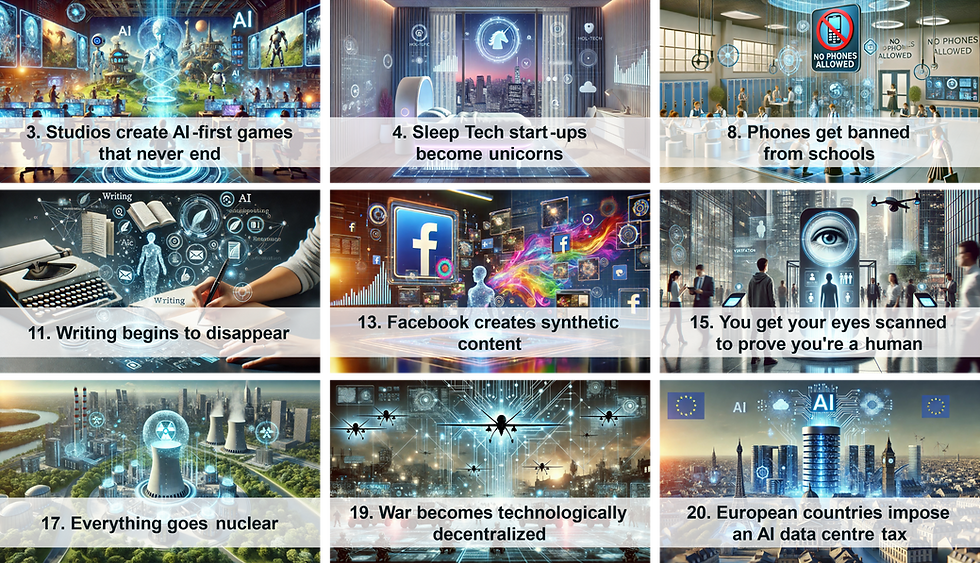
12. Writing begins to disappear
Despite being the oldest and most common form of human communication, voice has never really worked as an interface for engaging with technology. Alexa and Siri have always been disappointments, used for playing music, checking the weather… and little else.
Today, however, the evolution of large language models promises dramatically improved voice assistants (if you haven’t tried ChatGPT speech-to-speech models, you should). The digital world hasn’t fully caught up yet; existing apps aren’t naturally equipped to build / accommodate voice experiences. Neither is our hardware, in fact. In 2026, this will change. Smart glasses, wearables, and AI assistants are facilitating this shift, enabling people to communicate, create, and consume content through spoken language and visual interfaces.
This shift has profound implications. Writing, once a cornerstone of human expression and culture, is becoming a niche skill, akin to calligraphy or cursive handwriting. After all, it came to be as a way to replace memory… but everything is automatically recorded today? An example I like to use : WhatsApp users send 7 billion voice messages per day. We don’t want to write.
And so, schools may deprioritize teaching it, focusing instead on multimedia skills and digital fluency. At the same time, AI-generated content raises questions about originality, creativity, and trust.
In 2026, we’ll begin to grapple with the idea that writing, long viewed as an indispensable tool, is no longer the default way humans connect, share, and preserve their ideas.
Resolution criteria: at least one G7 official education authority formally reduces writing requirements (handwriting / extended composition).
13. War becomes technologically decentralized
Right now, most AI tools live in somewhat distant data centers, which is fine until you need lightning-fast responses (data has to travel back and forth, which takes precious tens of milliseconds).
That’s where specialized silicon chips come in. These next-generation chips will handle AI tasks , like identifying images or answering prompts, right on the device, cutting down latency / nearing real-time and granting real independence from critical infrastructure. If the above explanation feels unsatisfying, trust your instincts : it’s years worth of expertise crammed into the simplest possible paragraph.
The shift from compute on “the cloud” to “on device” won’t just show up in smartphones; it will entirely reshape warfare. Imagine a drone that can spot, lock onto, and fire at a target all on its own, without relying on a human operator or vulnerable communication links. No one’s 100% sure whether such experiments are already underway, but it sure looks like it: a company called Auterion is supplying 33 000 AI drone guidance kits to Ukraine, enabling manually piloted strike drones to autonomously track and hit targets during the terminal phase
Scary? Definitely. But the rise of autonomous weapons (“killer robots”) feels inevitable; not just because of capability, but because governance is lagging behind engineering. The future of war is moving toward on-device AI, whether we like it or not.
Resolution criteria: independently verified battlefield use of “offline autonomy” kill-chains, defined here as weapons / vehicles running on-device AI that can navigate, identify / track a target and complete an attack without continuous comms or cloud support.
One last thing…
For the past 10 years, the tech world has not really delivered on its many promises. Just more monitoring, more nudging, more draining of our data, our time, our joy.
In 2026, let us hope that the industry goes back to doing hard, but necessary work of improving lives. That we invent new tools to help reduce infant mortality, deaths from infectious disease and wealth inequalities between the poorest and wealthiest nations. That great medical advances are made, that education is further democratized, and that green technologies emerges as a long-term force for good. Fingers crossed.
Good luck out there.


Comments